AI from the Ground Up · Part 1
The Story of AI
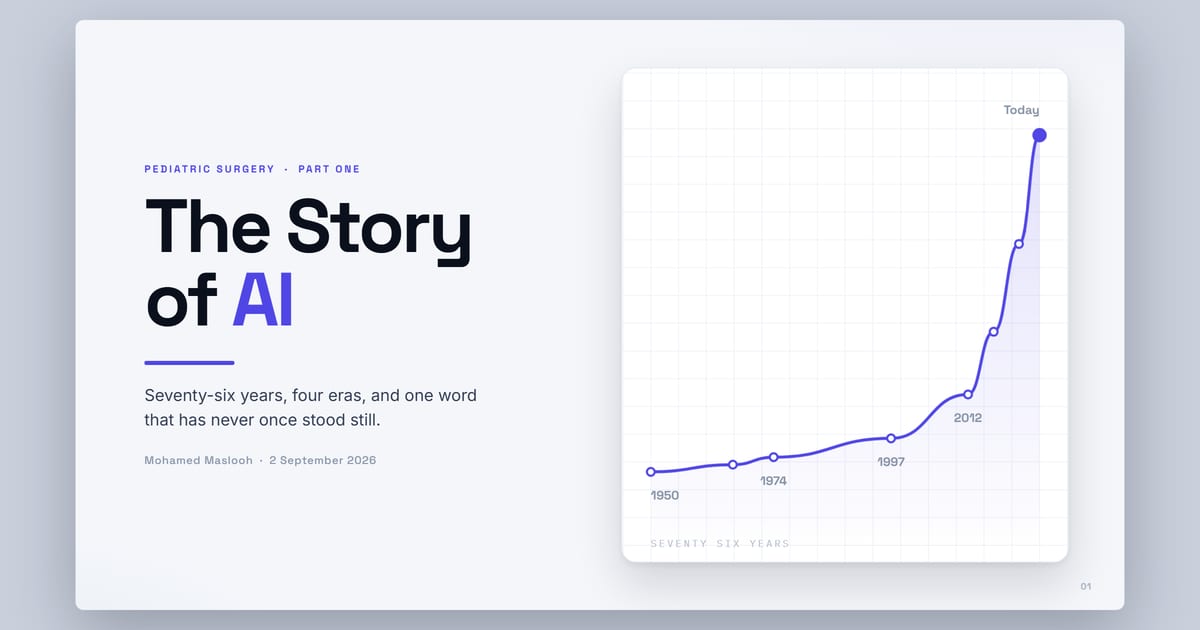
Seventy-six years, four eras, and one word that has never once stood still.
It generates, it does not retrieve. And you are the failure mode.
Share this lecture

The rest of the series
- 01The Story of AIYou are here
- 02Why It Makes Things Up
- 03The AI Race
About this lecture
The Story of AI is the first lecture in Dr. Mohamed Maslooh's series AI from the Ground Up, given on 2 September 2026 at the Wednesday staff round of the Department of Pediatric Surgery, Kasr Al-Ainy, Cairo. It tells the history of artificial intelligence across seventy-six years and four eras: rule-based systems, machine learning, generative AI and agentic AI. It moves from Alan Turing's 1950 question to ChatGPT and today's agents, and it ends with one lesson: the word AI covers three different technologies, and each deserves a different level of trust. The slides are in English and the lecture was delivered in Egyptian Arabic.
- The rule-based era ran from Alan Turing's 1950 question, Can machines think?, through the 1955 Dartmouth proposal that named the field, to IBM's Deep Blue beating Garry Kasparov at chess in 1997.
- MYCIN, a hand-written rule system from 1974, chose acceptable antibiotic therapy in 65% of test cases against 55.5% for Stanford faculty, yet it never treated a single real patient, because nobody could feed it, it did not fit the working day, and nobody would sign for its decisions.
- Machine learning replaced written rules with examples: in 2012 a neural network from Toronto cut the error in naming what is in a photograph to 15.3%, against 26.2% for the best hand-written system.
- Generative AI rests on the transformer, published by Google in June 2017, and it does not look answers up: it guesses the next word, one word at a time. ChatGPT, released on 30 November 2022, reached one million users in 5 days.
- The closing lesson: rules we wrote are trusted only inside their rules, patterns a machine learned are trusted only where they were measured, and a machine that guesses the next word should never be trusted unchecked on a fact.
Questions
What are the four eras of artificial intelligence?
In Dr. Mohamed Maslooh's lecture The Story of AI, the four eras are the rule-based era (1950 to the 1980s), the machine learning era (1986 to 2015), generative AI (2017 to 2022) and agentic AI (2023 to now). Each era changed what the word AI meant, and the agentic era is described as the newest and least settled.
Does ChatGPT look up its answers?
No. ChatGPT and similar models are built on the transformer design that Google published in 2017. They do not retrieve an answer from a store of facts: they predict the next likely word, one word at a time, from fixed weights. That makes them fluent on almost any topic, but nothing in that process checks whether a fact is true, unless the model is given a search tool or the source itself.
What is the difference between an AI chatbot and an AI agent?
A chat assistant answers and then stops, leaving you to do the work. An agent takes the same request and acts on it with tools: in the lecture's example it checks a calendar, searches the web for a restaurant, fills in the booking form and emails everyone. The lecture notes that as of 2026 agents are the least mature of the four eras.
Who gave The Story of AI lecture, and can I see the slides?
Dr. Mohamed Maslooh, a medical intern at Kasr Al-Ainy, gave it on 2 September 2026 as the first lecture of his series AI from the Ground Up, at the Wednesday staff round of the Department of Pediatric Surgery. The slides open free in any browser at maslooh.com/lectures/the-story-of-ai.
Is AI better than doctors at diagnosis?
In one randomised study of 50 physicians cited in the lecture (Goh et al., JAMA Network Open, 2024), the model alone scored a median 92% on diagnostic reasoning, doctors working as usual 73.7%, and doctors given the model 76.3%. Giving doctors the tool barely moved their score, which shows that access alone is not the same as benefit.